Here’s what you need to keep in mind
Welding Stainless Steel
Are you wondering how stainless steel welding works? In this guide, we’ll answer all your questions about stainless steel welding!
1,500+
Satisfied Customers
5,500+
Available Machines
0.11%
Complaint Rate








Stainless Steel Welding
Here’s what you need to keep in mind
When it comes to welding, a quick online search turns up plenty of results. Yet there’s rarely any mention of welding stainless steel. Meanwhile, thanks to its properties, it’s a very popular material for many applications.
Why is that? Is the welding process even suitable for stainless steel? And if so, what welding processes are available, and what needs to be considered? We have the answers.

Perfect components in just 3 steps!
1
Make a request
Upload production drawing and specify order. You will receive your offer within 48 hours.
2
Quality control
We find the right paver, supervise production and take care of quality control in our in-house measuring center.
3
Components received
You receive your quality-tested components including detailed test certificate.
Get a quote for your parts
We will send you a suitable offer within 48 hours
Short answer: Yes
Is it even possible to weld stainless steel?
Just like conventional steel, stainless steel parts can also be joined together by welding. Welding is the recommended method for stainless steel as well. There are three reasons for this:
- For one thing, it is the most stable connection method.
- Second, it is generally also the more cost-effective option compared to riveting or screwing, which would require more material.
- And third, the final product—which was welded—weighs significantly less precisely because of the point just mentioned.
Professionally welded stainless steel joints are highly durable and temperature-resistant, making them suitable for both indoor and outdoor use.
Welding stainless steel is a skill that must be learned
The Role of a Professional
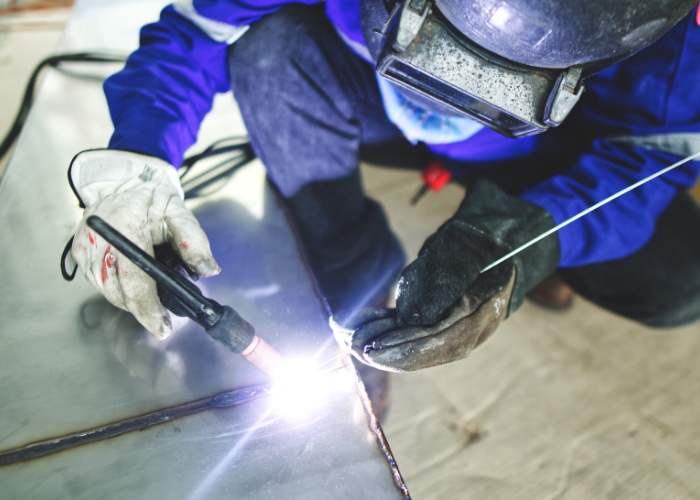
Stainless steel welding is not necessarily a task for amateurs. While the welding process itself may be relatively simple to perform, the crux of the matter is that most welded joints in stainless steel are clearly visible. If one wishes to achieve a flawless visual result—which is often expected with this material—the welder must be able to work with precision and skill.
Different Requirements
In the medical and chemical sectors in particular, there are also strict requirements for welding work related to the subsequent use of stainless steel products. To fully meet these requirements, a thorough understanding of the regulations, welding processes, and stainless steel itself is absolutely essential.
The continuous alignment of workpieces
An Overview of Four Welding Processes
1. MMA Welding
MMA welding is also known as arc welding, electrode welding, or manual arc welding. In this welding process, a welding rod in the electrode holder serves as the welding electrode, and the arc is formed between the welding rod and the stainless steel part being welded. While the rod does not shorten during MIG/MAG welding , this is exactly what happens during MMA welding.
It is therefore essential to move the electrode holder toward the workpiece. While the distance to the welding torch does not need to be kept constant, it must, of course, be monitored. MMA welding is one of the most common methods for welding steel or stainless steel joints. It is flexible and is used in a wide range of industries. It is also suitable for working on thicker stainless steel joints.
2. TIG Welding
Tungsten Inert Gas (TIG) welding is a fusion welding process. The process involves the use of a shielding gas. To ensure a flawless weld, a filler material compatible with the base metal is used, and the molten zone is shielded with argon. Modern TIG welding machines feature a lead-in and lead-out system, which, thanks to its design, reliably protects the weld bead from corrosion.
TIG welding is also very popular and can be used for stainless steels, as well as for aluminum-stainless steel alloys, nickel, and even for working with titanium. In contrast to MMA welding, welds produced by TIG welding are usually free of spatter. It is particularly noteworthy that word of the quality of this process has even spread to the aerospace industry, where it is used frequently.
3. MIG Welding
The MIG welding process is a semi-automatic welding technique. As with TIG welding, a shielding gas is used—in this case, an inert gas. The inert gases used are typically argon, helium, or a mixture of both. These are preferred because they do not react with filler materials, allowing for higher welding temperatures. This process can prove to be more cost-effective.
In contrast to MAG welding, MIG can generally be described as faster and therefore more economical. This is particularly true when automated processes are incorporated, as this allows for even faster joining. From an economic standpoint, it’s a win-win situation.
4. Orbital Welding
This specialized welding process, which evolved from the TIG welding method, can also be used for welding stainless steel pipes. During the process, the torch rotates automatically. This technique is particularly in demand in the pharmaceutical industry and for the manufacture of products used in the food industry.
Orbital welding is one of the most challenging methods for welding stainless steel. The welder must be able to position the weld with great precision, which requires a great deal of expertise and skill. Deviations are unacceptable, especially when it comes to equipment intended for food or pharmaceutical use. The approval of such equipment is strictly regulated.
Get a quote for your parts
We will send you a suitable offer within 48 hours
Good to Know
Here’s What You Need to Keep in Mind When Welding Stainless Steel
Anyone who manufactures stainless steel parts for industrial use must, in many cases, meet certain requirements. These are often not limited to technical skills alone but also require, in some cases, a certain amount of knowledge of bureaucratic procedures.
Here are a few tips and pointers:

For acceptance purposes, every professional welder must submit a welding plan before beginning work. This applies in particular to the welding of stainless steel or other materials within the following industries:
- Semiconductor Industry
- Food Industry
- Oil and Gas Industry
- Nuclear Industry
Above all, this welding plan must include the following points:
- Base materials and filler materials, plus certificates
- Approval of the respective welding process
- Valid Certificate of Qualification (Welding Certificate)
Relevant information can be obtained from the EFSA (European Food Safety Authority) or the European Medicines Agency (EMA).
- Stainless steels, such as stainless steel, must be welded in what is known as a “white zone.” This also means that no carbon steel may be present in this zone.
- For welded piping, it is not uncommon for X-ray inspections (non-destructive testing, NDT) to be required under actual operating pressure. To perform these inspections, you or the person in charge must be officially authorized.
- When using shielding gases at high temperatures, you are exposed to combustion fumes that may be hazardous to your health. Therefore, play it safe and wear respiratory protection. Also, be sure to follow all safety precautions regarding the use of electricity.
Experience you can build on
The CNC24 team combines over 30 years of experience in the production of precision components
500+
Finished
5.500+
Machines
80.000
Machine hours / Day
22
Countries
1.500+
Customers
6.000+
Orders
500.000
Individual parts
30 years
Manufacturing experience
Conclusion
Have your stainless steel welded by a professional today
Would you prefer to outsource your stainless steel welding or the entire production chain for your components? Nothing could be easier! With CNC24 as your partner, that means you won’t have to worry about a thing once you’ve placed your order. Just leave the work to us!
As a professional Industry 4.0 digital manufacturer, we offer all innovative CNC production processes. Our customers benefit from a wide range of additional services. We’re happy to provide this extra level of service, and thanks to our many years of expertise and a fleet of state-of-the-art CNC machines, we’re able to fulfill even the most unusual requests. And when time is of the essence, we also offer express manufacturing within 72 hours.
Does that sound good to you? Then get in touch with us today. We’ll send you a quote tailored to your project within 48 hours.

Get a quote for your parts
We will send you a suitable offer within 48 hours
Your partner for all components
Other manufacturing processes
What we produce
Our sample components
CNC24
The easiest way to order components